歡迎來到 Micron.com,請登入或註冊帳戶以繼續。
輸入無效。不支援特殊字元。
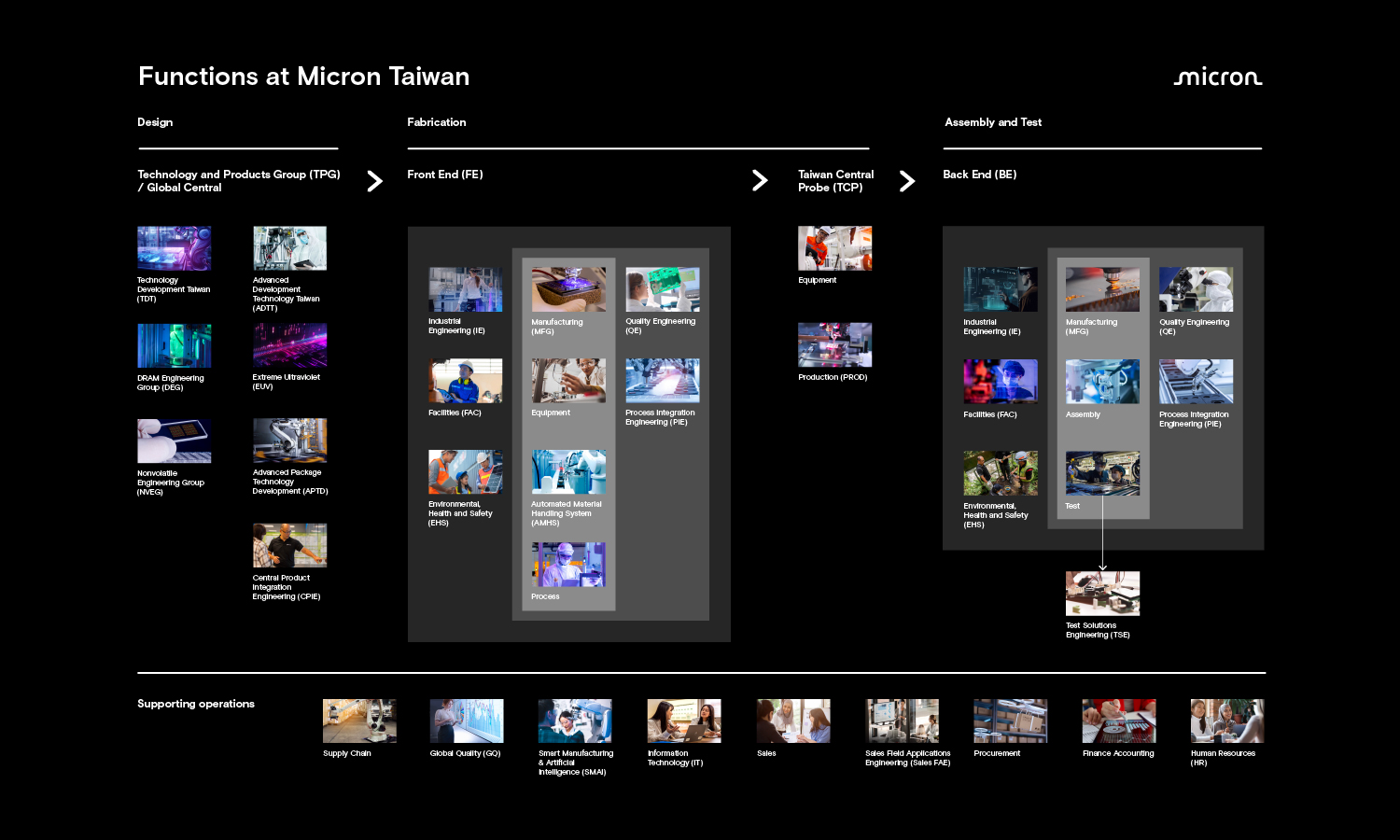
Technology and Products Group (TPG) / Global Central
DRAM Engineering Group
What does the DRAM Engineering Group do?
The DRAM Engineering Group (DEG) focuses on improving yield rate and quality, delivers DRAM products quickly and cooperates with research and development (R&D) and design teams in the U.S., Japan and Germany to develop new products.
Who does the DEG collaborate with?
Nonvolatile Engineering
What does the Nonvolatile Engineering team do?
The Nonvolatile Engineering (NVEG) team specializes in NAND flash design and manufacturing, as well as in related solutions such as storage solutions for PCs, data centers, mobile devices and automotive devices. Our Taiwan site includes application-specific integrated circuit (ASIC) design teams, system architecture teams and product testing and verification teams.
ASIC design engineers are core technical contributors to controller design and implementation methods and the design quality check. Responsibilities include inspecting full-chip and block-level design and quality and establishing design verification methods. They need to work closely with global front-end design and back-end implementation teams on different projects.
One part of NVEG is product test and validation engineers, who specialize in new product introduction and high-volume manufacturing. These engineers are also an important bridge between design, manufacturing and product teams. Their responsibilities include ensuring the quality of chip mass production, optimizing the test verification process and improving product yield.
Who does the NVEG collaborate with?
Technology Development Taiwan
What does the Technology Development Taiwan team do?
The Technology Development Taiwan (TDT) team is responsible for process development of each new generation of DRAM, focusing on process optimization to improve product quality, yield and reliability. The goal is to achieve a lower cost and higher productivity during process development.
Who does the TDT team collaborate with?
Extreme Ultraviolet
What does the Extreme Ultraviolet team do?
The Extreme Ultraviolet (EUV) team is responsible for research and development (R&D) on Micron's EUV advanced lithography technology, yield rate optimization and productivity improvement. The team works as the bridge between R&D and the mass production divisions to introduce the EUV lithography process into mass production.
Who does the EUV team collaborate with?
Advanced Development Technology Team
What does the Advanced Development Technology Team do?
The Advanced Development Technology Team (ADTT) is the bridge between research and development (R&D) and manufacturing. It introduces the latest Micron technology and optimizes the production process and formula, thereby increasing the yield rate.
Who does the ADTT collaborate with?
Central Product Integration Engineering
What does the Central Product Integration Engineering team do?
The Central Product Integration Engineering (CPIE) team is responsible for optimizing the process and improving product quality with local integration units. More importantly, this team extends the best solution to a problem to Micron’s global plants and facilitates overall progress and growth.
Who does the CPIE team collaborate with?
Advanced Package Technology Development
What does the Advanced Package Technology Development team do?
The Advanced Package Technology Development (APTD) team focuses on becoming a leader in packaging technology for memory and storage solutions. The goal is to deliver world-class packaging solutions that differentiate and accelerate Micron’s technology and cost leadership in the industry.
Who does the APTD team collaborate with?
DRAM Engineering Group (DEG)
Nonvolatile Engineering Group (NVEG)
Technology Development Taiwan (TDT)
Extreme Ultraviolet (EUV)
Advanced Development Technology Taiwan (ADTT)
Central Product Integration Engineering (CPIE)
Advanced Package Technology Development (APTD)
Front-End (FE)
Industrial Engineering
What does the Industrial Engineering team do?
The Industrial Engineering (IE) team uses industry concepts for capacity modeling, providing long-term capital expenditure plans to support new tech-node conversion. This team relies on strong communication skills to work with different teams on a variety of tasks. Those tasks include conducting strategic analyses to optimize tool purchasing proposals, continuously improving and optimizing the capacity parameters, planning and checking the delta between model values and actual performance, defining mitigation plans to enhance gaps, checking the accuracy of capacity modeling, ensuring that capacity preparation meets company output goals; building up tool models to support new tech-node dynamic conversion and evaluating capital requirements.
Who does the IE team collaborate with?
Manufacturing
What does the Manufacturing team do?
The Manufacturing (MFG) team solves exceptions on the production line, improves production capacity, works continuously to reduce workloads and determine production priorities, oversees the status of production lines, analyzes production-related data, provides dynamic strategies and achieves daily output goals.
Who does the MFG team collaborate with?
Equipment
What does the Equipment team do?
The Equipment team is foundational in semiconductor manufacturing. The Equipment team's engineers are scheduled during night and day shifts and work on all machines to ensure proper functioning. They maintain and troubleshoot machines and work with other groups to communicate with suppliers, improve cost structure and plan capacity demand.
Who does the Equipment team collaborate with?
Automated Material Handling System
What does the Automated Material Handling System unit do?
The Automated Material Handling System (AMHS) is a logistics unit in the fab that moves items. The AMHS unit has many wafer storage spaces, transport vehicles and a complex route network. Their most important task is to take wafer FOUPs (front-opening unified pods) from one machine and send them efficiently to the next reserved machine. Other important tasks include not only maintaining relevant equipment but also planning routes and keeping the route network unblocked. In addition to logistics-related work, the AMHS unit is responsible for a small number of machines and manufacturing processes. Although this accounts for a small percentage, the unit can be said to be "small but complete in every detail."
Who does the AMHS unit collaborate with?
Process
What does the Process team do?
The Process team achieves a balance between enhancing quality and yield and producing the maximum profit for the company. For every issue, the team tries to find the best solution without affecting product quality. The best solution also saves manufacturing costs, identifies any problems during production (such as quality changes) and finds ways to solve these changes so that production can return to normal.
When there is spare capacity, the Process group tries to improve yield rates, increase production capacity, and reduce manufacturing work hours to save labor and cost. Achieving these goals may require adjustments to the manufacturing process.
Who does the Process team collaborate with?
Process Integration Engineering
What does the Process Integration Engineering team do?
The Process Integration Engineering (PIE) team evaluates the testing of new equipment and materials, improves the manufacturing process, analyzes yields and exceptions and reduces production costs to ensure that each stage of the manufacturing process is correctly and accurately conducted. Additionally, this team cooperates with the staff responsible for each process module to increase yield and production rates.
Who does the PIE team collaborate with?
Quality Engineering
What does the Quality Engineering team do?
The Quality Engineering (QE) team monitors the quality of production lines using statistical methods and control charts. They use quality indicators to observe production stability, tiny excursions, continuous excursions and other issues. The engineers use the observed results to give tips or guidelines to the engineering unit to implement short-term, mid-term and long-term improvement plans and ensure long-term quality stability. The QE team also adopts automated tools to simplify workflows.
Who does the QE team collaborate with?
Environmental, Health and Safety
What does the Environmental, Health and Safety team do?
The Environmental, Health and Safety (EHS) team is the primary contact for product inquiries and is responsible for new DRAM products and coordination of product resources, testing and analysis within their lifecycles. The EHS team cooperates with various divisions of engineering, manufacturing and quality assurance to troubleshoot, develop and verify equipment test procedures. They also track the testing requirements after any products are returned by customers to meet specific product requirements, evaluate data sheets and provide feedback to increase product reliability.
Who does the EHS team collaborate with?
Facilities
What does the Facilities team do?
The Facilities (FAC) team is divided into six sections (water, electricity, gas chemistry, air conditioning, system integration and general affairs). Facility engineers are responsible for the operations and maintenance of the systems in the factory. Working different shifts is required to deal with system abnormalities, operations and maintenance. They also manage and control team members, material resources, cost and time to ensure product quality and smooth operations. When facility engineers are familiar with the operation of each system and can systematically improve and integrate resources, they can take on responsibility for daily projects and cooperate with internet of things (IoT) engineers in the factory to introduce smart facility management systems. Through data and an integrated system the team can reduce human error and enable a better facility management environment.
Who does the FAC team collaborate with?
Industrial Engineering (IE)
Manufacturing (MFG)
Equipment
Automated Material Handling System (AMHS)
Process
Process Integration Engineering (PIE)
Quality Engineering (QE)
Environmental, Health and Safety (EHS)
Facilities (FAC)
Taiwan Central Probe (TCP)
Equipment
What does the Equipment team do?
The Equipment team deals with online problems, solves them immediately and responds to their leaders in real-time. Members of this team work either night or day shifts to accelerate their understanding of the machines, deploy probe cards and establish the wafer measurement plant that can realize high-quality and high-volume output.
Who does the Equipment team collaborate with?
Production
What does the Production team do?
The Production (PROD) team is responsible for either day and night shifts to manage production line team members, supervise the completion rate of the production line, handle and troubleshoot any production-line issues in a timely manner and focus on the process of a specific area. The PROD team cooperates and communicates with various teams, enhances and adjusts the management process of the production line, and realizes the daily production capacity goals. Although the PROD team discovers and solves production line exceptions and continuously improves product performance and KPIs, its members can also work on daily projects such as cost improvement, supplier communication and capacity demand planning. Being successful in this position requires the ability to judge situations, handle priorities and manage the production lines to maximize production capacity and outputs.
Who does the Production team collaborate with?
Equipment
Production (PROD)
Back-End (BE)
Industrial Engineering
What does the Industrial Engineering team do?
The Industrial Engineering (IE) team uses industry concepts for capacity modeling, providing long-term capital expenditure (capex) plans to support new tech-node conversion. This team relies on strong communication skills to work with different teams on their tasks. Those tasks include conducting strategic analyses to optimize tool purchasing proposals, continuously improving and optimizing the capacity parameters, planning and checking the delta between model value and actual performance, defining mitigation plans to enhance gaps, checking the accuracy of capacity modeling, ensuring that capacity preparation meets company output goals; building up tool models to support new tech-node dynamic conversion and evaluating capital requirements.
Who does the IE team collaborate with?
Manufacturing
What does the Manufacturing team do?
The Manufacturing (MFG) team creates production plans and prioritizes product quality to achieve output goals. Coordinating daily operations, the equipment engineers properly maintain the machines to ensure stable outputs and cooperate with manufacturing process staff to maintain manufacturing process stability. They supervise the production line status and manage personnel, deal with production line problems, and implement production plans into practice to achieve goals.
Who does the MFG team collaborate with?
Process Integration Engineering
What does the Process Integration Engineering team do?
The Process Integration Engineering (PIE) team integrates the manufacturing process and confirms the introduction of new products, improves production and manufacturing procedures and increases the process’s yield rate. The PIE team is also involved in reviewing new products, solving problems and improving processes, and defining various product indicators. They also provide good materials, suggestions and improvement plans, and their efforts improve the yield rate of mass-produced products to achieve maximum production efficiency.
Who does the PIE team collaborate with?
Test Solutions Engineering
What does the Test Solutions Engineering team do?
The Test Solutions Engineering (TSE) team provides complete, high-efficiency, effective global test solutions, collaborates with upstream and downstream groups based on product characterization and does strategic test capacity planning to achieve best-in-class on cost. The TSE team also participates in product test analyses to facilitate process deviation improvements and enhance yield, customer quality and comparative cost advantage.
Who does the TSE team collaborate with?
Assembly
What does the Assembly team do?
The Assembly team keeps the production lines stable, maintains product quality, improves yields, increases output to meet customer expectations, reduces production costs and maximizes profits. This team also maintains the machines and maximizes output.
Who does the Assembly team collaborate with?
Test
What does the Test team do?
The Test team participates in product testing, cost and quality improvement programs, and evaluation of improvements on the product cycle. In the testing process, they develop product improvement structures and provide solutions. The Test team offers continuous improvement plans for operational efficiency and productivity, confirms the cause of product abnormalities, works out the improvement plan and designs preventive measures. Its members also acquire yield rate data and analyze the modes of failure.
Who does the Test team collaborate with?
Quality Engineering
What does the Quality Engineering team do?
The Quality Engineering (QE) team establishes effective problem-solving methods, focusing on product quality improvements, and ensures that products meet customer requirements. The QE team also manages product returns for customers and supervises the status of exceptions. This team confirms and deals with substandard products and prevents substandard products from being delivered to customers.
Who does the QE team collaborate with?
Environmental, Health and Safety
What does the Environmental, Health and Safety team do?
The Environmental, Health and Safety (EHS) team is the primary contact for product inquiries and is responsible for new DRAM products and coordination of product resources, testing and analysis within their lifecycles. The EHS team cooperates with various divisions of engineering, manufacturing and quality assurance to troubleshoot, develop and verify equipment test procedures. They also track the testing requirements after any products are returned by customers, to meet specific product requirements, evaluate data sheets, and provide feedback to increase product reliability.
Who does the EHS team collaborate with?
Facilities
What does the Facilities team do?
The Facilities (FAC) team is divided into six sections (water, electricity, gas chemistry, air conditioning, system integration and general affairs). Facility engineers are responsible for the operations and maintenance of the systems in the factory. Working different shifts is required to deal with system abnormalities, operations and maintenance. They also manage and control team members, material resources, cost and time to ensure product quality and smooth operations. When facility engineers are familiar with the operation of each system and can systematically improve and integrate resources, they can take on responsibility for daily projects and cooperate with internet of things (IoT) engineers in the factory to introduce a smart facility management system. The data and integrated systems can reduce human error and enable a better facility management environment.
Who does the FAC team collaborate with?
Industrial Engineering (IE)
Manufacturing (MFG)
Process Integration Engineering (PIE)
Test Solutions Engineering (TSE)
Assembly
Test
Quality Engineering (QE)
Environmental, Health and Safety (EHS)
Facilities (FAC)
Supporting Operations
Supply Chain
What does the Supply Chain team do?
The Supply Chain team is the bridge between the sales and manufacturing teams. It converts clients' orders into work orders that the Manufacturing team works on. Using delivery dates specified in clients’ orders, the Supply Chain team provides the priorities for the Manufacturing team’s production line.
Who does the Supply Chain team collaborate with?
Global Quality
What does the Global Quality team do?
Given the need for high quality of Micron’s shipped DRAM products, the Global Quality (GQ) team ensures that customers experience low defect rates. This process includes strict monitoring of wafer manufacturing, particle packaging manufacturing, and DRAM module packaging manufacturing. The GQ team sets quality sampling at each of the sites. They conduct data analysis on the items that exceed the defect progression monitoring (DPM) standard, identify possible key problems, report them to the manufacturing unit and take immediate action to prevent problematic products from being shipped. They also monitor the DPM of the customer side and adopt data analysis methods to improve product quality so that Micron becomes the No. 1 supplier of the best quality products.
Who does the GQ team collaborate with?
Smart Manufacturing & Artificial Intelligence
What does the Smart Manufacturing & Artificial Intelligence team do?
The Smart Manufacturing & Artificial Intelligence (SMAI) team is responsible for integrating technologies such as industrial internet of things (IIoT), big data, AI, ML and cloud computing into Micron’s fabs, making them highly automated modern fabs. The SMAI team further develops solutions for more intelligent applications, production and processes, and intelligent energy management and then deploys these solutions to each Micron plant. The goal is to improve manufacturing efficiency, enhance product quality, reduce production costs and ensure Micron’s leadership in intelligent manufacturing.
Who does the SMAI team collaborate with?
Information Technology
What does the Information Technology team do?
The Information Technology (IT) team uses innovative solutions and new technology applications to develop software for intelligent factory systems. This team covers system development, data engineering and the industrial internet of things (IIOT)to enhance product quality and improve productivity.
Who does the IT team collaborate with?
Sales
What does the Sales team do?
The Sales team assists clients in planning, mastering and forecasting their product needs. The team also reaches performance goals, resolves conflicts between clients and the company, internally coordinates resources with the business units and coordinates shipment time with sales assistants.
Who does the Sales team collaborate with?
Sales Field Applications Engineering
What does the Sales Field Applications Engineering team do?
The Sales Field Applications Engineering (Sales FAE) team introduces new products to clients and shows the clients how to use them. This team provides technical skills and expertise through sales demos, product presentations, and installation and maintenance of company products. The Sales FAE team helps sales staff evaluate the potential applications of Micron's products to meet client needs and prepares detailed product specifications for the development and implementation of customer applications and solutions.
Who does the Sales FAE team collaborate with?
Procurement
What does the Procurement team do?
The Procurement team is the point of contact for suppliers, managing performance and negotiating commercial terms. This team works closely with internal stakeholders to establish a comprehensive management plan for supplier performance and ensure a consistent supply of materials. In addition, the Procurement team is responsible for driving cost-reduction plans, managing supply risks and building negotiation plan strategies. Through managing, leading and executing strategies, the team optimizes costs and strengthens supply quality. In addition, the Procurement team solves supplier-related issues and manages the collection and evaluation of performance information and feedback from business reviews.
Who does the Procurement team collaborate with?
Finance Accounting
What does the Finance Accounting team do?
The Finance Accounting team prepares budgets, analyzes manufacturing costs, conducts technical analyses to determine current and future financial performance and collects, analyzes, prepares and summarizes recommendations on financial plans, acquisition activities, future-trend requirements and forecasts for the business. The team also conducts economic research on return rates, product depreciation, capital requirements, investment opportunities, investment performance and the impact of public-sector requirements.
Who does the Finance Accounting team collaborate with?
Human Resources
What does the Human Resources team do?
The Human Resources (HR) team is divided into recruitment, salary and benefits, employee relations, business partners, employee training and talent development. The HR team assists different groups based on professional functions such as attracting, training and developing talent, managing policies for adopting and retaining talent, and addressing team member-care issues. The HR team analyzes its ongoing situation and provides solutions for any problems.